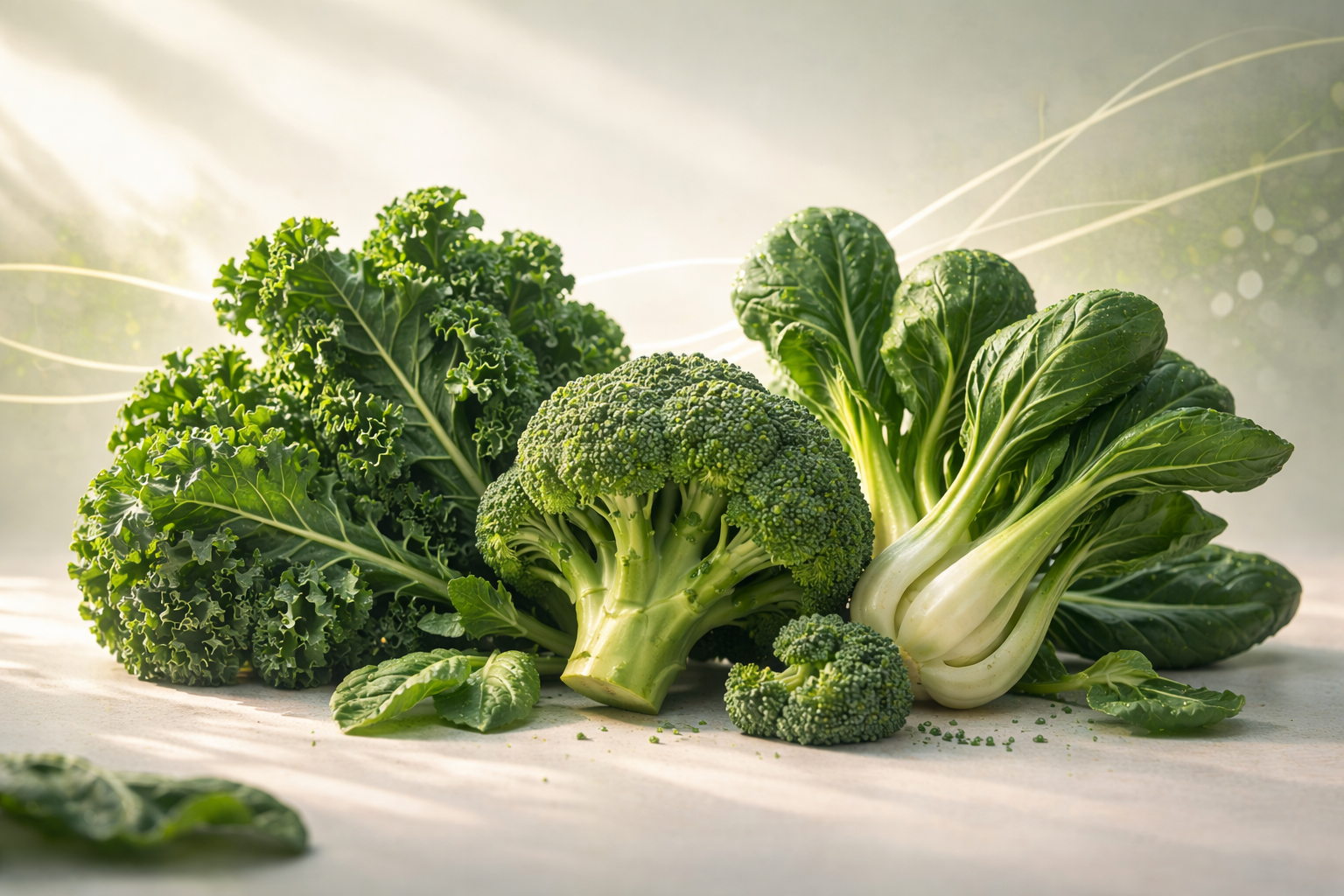
How crucifers modulate hormonal signaling to protect long-term metabolism
Goitrogens are usually introduced with a warning.
They’re said to block iodine.
Suppress thyroid function.
Slow metabolism.
If you care about energy, fat loss, or performance, that framing immediately raises concern.
And yet many of the most nutrient-dense foods people eat regularly—kale, broccoli, cabbage, arugula, bok choy—contain goitrogenic compounds.
If goitrogens were inherently harmful, this would be a contradiction.
It isn’t.
What Goitrogens Actually Do
Goitrogens are naturally occurring compounds found primarily in cruciferous vegetables and some leafy greens. They interact with iodine metabolism and thyroid hormone signaling.
That interaction is usually described as interference.
A better word is modulation.
Goitrogens don’t shut the thyroid down. They influence how quickly thyroid signaling proceeds under certain conditions.
And in physiology, speed is rarely the same thing as health.
The Thyroid Is a Regulator, Not a Switch
The thyroid isn’t an on/off button.
It’s a pacing mechanism.
Thyroid hormones influence how fast cells turn over energy, how aggressively mitochondria work, how rapidly tissues respond to stress, and how quickly the body burns through resources.
Too little signaling feels sluggish.
Too much signaling feels anxious, inflamed, brittle, and unsustainable.
Long-term health depends on appropriate thyroid tone, not maximal output.
Why Slowing a Signal Can Be Protective
Goitrogens slightly reduce iodine uptake or slow thyroid hormone activation when iodine exposure is high or signaling pressure is excessive.
That matters because iodine, like iron, is essential—and reactive.
Excess iodine increases oxidative stress inside thyroid tissue itself. Over time, that can damage the gland and destabilize hormone production.
In that context, goitrogens act like a brake.
Not a shutdown.
A governor.
Context Changes the Outcome
In a well-fed system with adequate iodine, selenium, and overall metabolic support, goitrogens do not cause hypothyroidism.
They help prevent over-signaling.
In contrast, in a system that’s under-eating, inflamed, iodine-deficient, or chronically stressed, the same regulatory signal can feel restrictive.
The compound gets blamed.
But the buffering capacity was already low.
Why These Compounds Exist at All
Cruciferous plants didn’t evolve to sabotage thyroids.
They evolved in environments where mineral exposure fluctuated wildly.
Their compounds don’t assume abundance.
They assume variability.
Goitrogens help biological systems adjust signaling to conditions rather than forcing a constant metabolic pace regardless of cost.
That logic applies just as much to humans as it does to plants.
Cooking Isn’t an Admission of Guilt
Traditional cultures rarely consumed large amounts of raw cruciferous vegetables.
They cooked them.
Cooking softens goitrogenic activity without eliminating it. The signal becomes gentler, not absent.
This isn’t evidence that goitrogens are dangerous.
It’s evidence that humans learned how to tune the dial, not rip it out.
Raw forms create stronger signaling.
Cooked forms create steadier modulation.
Both have a place.
When Goitrogens Get Blamed
Goitrogens tend to feel problematic when multiple systems are already strained.
Low iodine.
Low selenium.
Chronic restriction.
Excess endurance stress without recovery.
High inflammation or autoimmune activity.
In those states, anything that slows metabolism feels threatening.
But slowing isn’t the same as suppressing.
Often, it’s protective.
The Familiar Pattern
Goitrogens follow the same pattern seen with other feared plant compounds.
Phytates regulate minerals.
Lectins pace carbohydrates.
Tannins manage protein interaction.
Oxalates buffer reactivity.
None of these exist to nourish directly.
They exist to regulate exposure.
Goitrogens do the same—at the level of hormonal signaling.
The Index Position
Goitrogens are not thyroid toxins.
They are thyroid-pacing compounds.
They help moderate iodine utilization, reduce oxidative stress in thyroid tissue, prevent runaway metabolic signaling, and support long-term hormonal stability.
They don’t damage healthy systems.
They reveal when systems are already under-supported.
The Final Word
The thyroid doesn’t need to be pushed.
It needs to be respected.
In a body built on real food, sufficient minerals, daily movement, and recovery, goitrogens don’t slow progress.
They protect it.
Once again, the problem isn’t plants.
It’s broken context.
Related Article: