Most people are taught to approach nutrition like a spreadsheet.
Calories in.
Calories out.
Macros tracked.
Portions weighed.
And on paper, that all looks logical.
But the body doesn’t run on numbers.
It runs on chemistry.
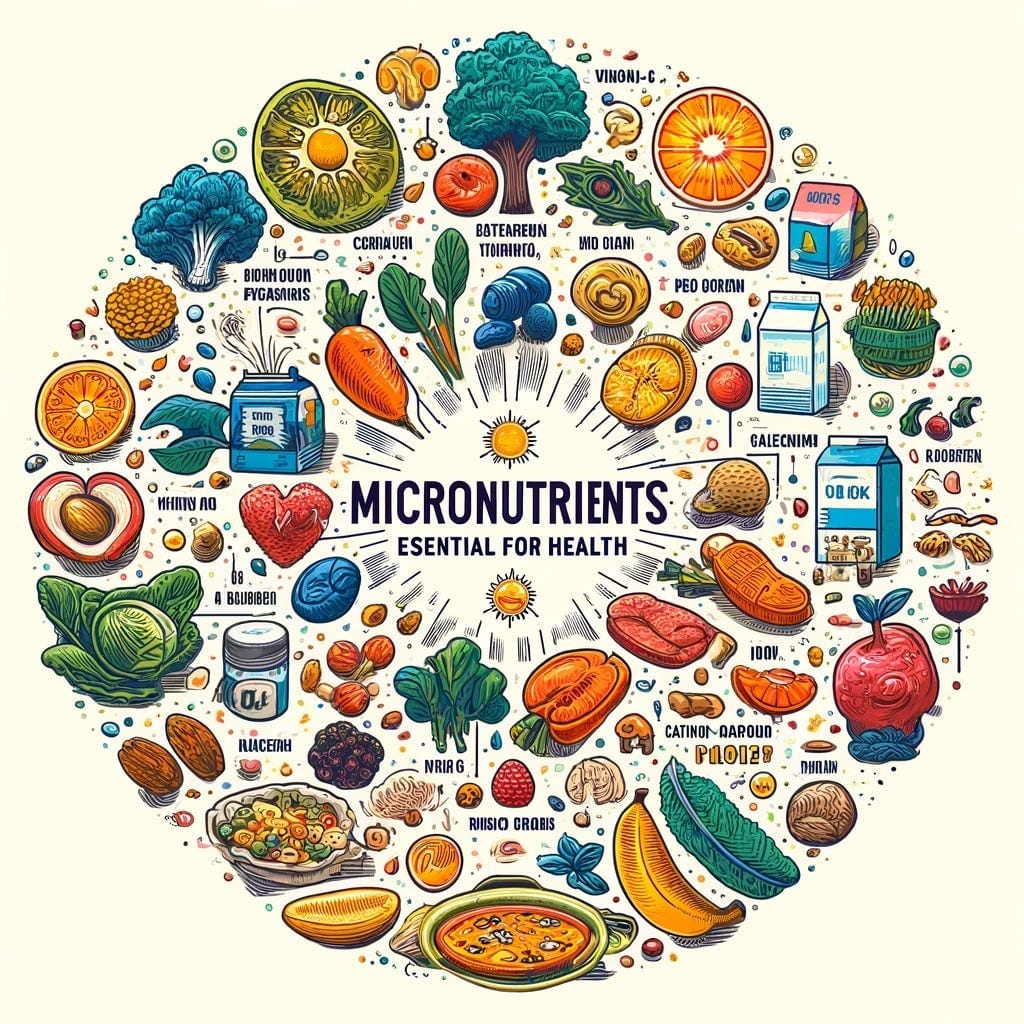
Calories are just potential. They’re raw material. Without the right instructions, they don’t become usable energy, tissue, hormones, or movement. Those instructions come from micronutrients — vitamins, minerals, and trace elements that quietly decide what food actually does once it enters the body.
Micronutrients don’t provide energy themselves. They make energy production possible.
They sit behind the scenes as enzyme cofactors, hormone regulators, electrical conductors, and structural components of tissue. They act as signals for repair and adaptation. Every major system depends on them — metabolism, the nervous system, cardiovascular function, bone density, immune response, testosterone and thyroid signaling.
When micronutrients are insufficient, the body doesn’t shut down immediately. It becomes inefficient. Slower. Less precise. And no amount of perfectly balanced macros can override that.
This is why two people can eat the same number of calories and experience completely different outcomes.
One body has the nutrient machinery to process food efficiently.
The other doesn’t.
A calorie from ultra-processed food arrives stripped of minerals, vitamins, phytonutrients, and enzymatic support. It asks the body to do more work with fewer tools. Over time, that shows up as poor energy conversion, hormonal disruption, inflammation, increased fat storage, and slower recovery.
This is how people end up eating less and feeling worse.
Fruits and vegetables change that equation.
Not because they’re trendy or virtuous, but because they’re dense with the micronutrients human physiology evolved to depend on. Fruits, vegetables, herbs, seeds, and nuts contain the highest concentration of these compounds — not exotic superfoods, not powders, not supplements.
Iron from leafy greens supports oxygen transport.
Magnesium regulates hundreds of enzymatic reactions.
Zinc supports immune function and testosterone signaling.
Calcium enables nerve transmission and muscular contraction.
And none of these work in isolation. They operate in networks, reinforcing one another. This is why whole foods consistently outperform isolated nutrients.
The real problem in modern nutrition isn’t starvation.
It’s deficiency.
Most people are eating enough — often too much — yet large portions of the population are low in magnesium, zinc, vitamin D, potassium, iron, and selenium. Deficiency doesn’t always announce itself dramatically. It shows up quietly as fatigue, poor recovery, low libido, brain fog, stubborn fat, chronic inflammation, or injuries that don’t heal.
The body adapts for a while.
Eventually, it runs out of margin.
Perfection isn’t the goal here.
Diversity is.
Rotating fruits and vegetables across days and weeks expands micronutrient coverage, supports microbiome diversity, and improves absorption and utilization. Eating different colors, following seasons, and repeating foods with variation isn’t a diet strategy — it’s how humans have always eaten.
The body thrives on range, not rigidity.
This matters even more once training becomes consistent.
Movement increases demand. Exercise burns nutrients, generates oxidative stress, and requires repair. If micronutrient intake doesn’t rise to meet that output, recovery slows, performance plateaus, and injuries accumulate.
This is why food quality becomes more important as training frequency increases — not less.
Calories tell you how much.
Micronutrients determine what happens next.
If you want efficient metabolism, stable hormones, clean energy, and long-term athletic fitness, food quality has to come before food quantity. Everything else is built on that foundation.