Why Regulating Iron Matters More Than Maximizing It for Long-Term Fitness
Iron is one of the most important nutrients in human physiology.
It forms hemoglobin, which carries oxygen in the blood.
It supports myoglobin, which stores oxygen in muscle.
It enables aerobic energy production inside mitochondria.
Without iron, endurance, cardiovascular efficiency, and sustainable fitness adaptation simply don’t happen.
But iron has a second side—one that rarely gets discussed with the same seriousness.
Iron is also highly reactive, pro-oxidative, and biologically dangerous in excess.
And how iron enters the body matters just as much as how much enters.
Iron Is Essential — and Potentially Destructive
Iron’s reactivity is what makes it useful for oxygen transport.
That same reactivity is what makes excess iron harmful.
When iron circulates freely and unregulated, it accelerates oxidative stress, damages mitochondrial membranes, disrupts cellular signaling, feeds pathogens and parasites, and increases overall inflammatory burden.
Unlike many nutrients, the body has no active pathway for iron excretion. Once iron accumulates, it tends to stay.
This makes regulation—not absorption speed—the defining factor for long-term health and fitness.
Two Very Different Iron Systems
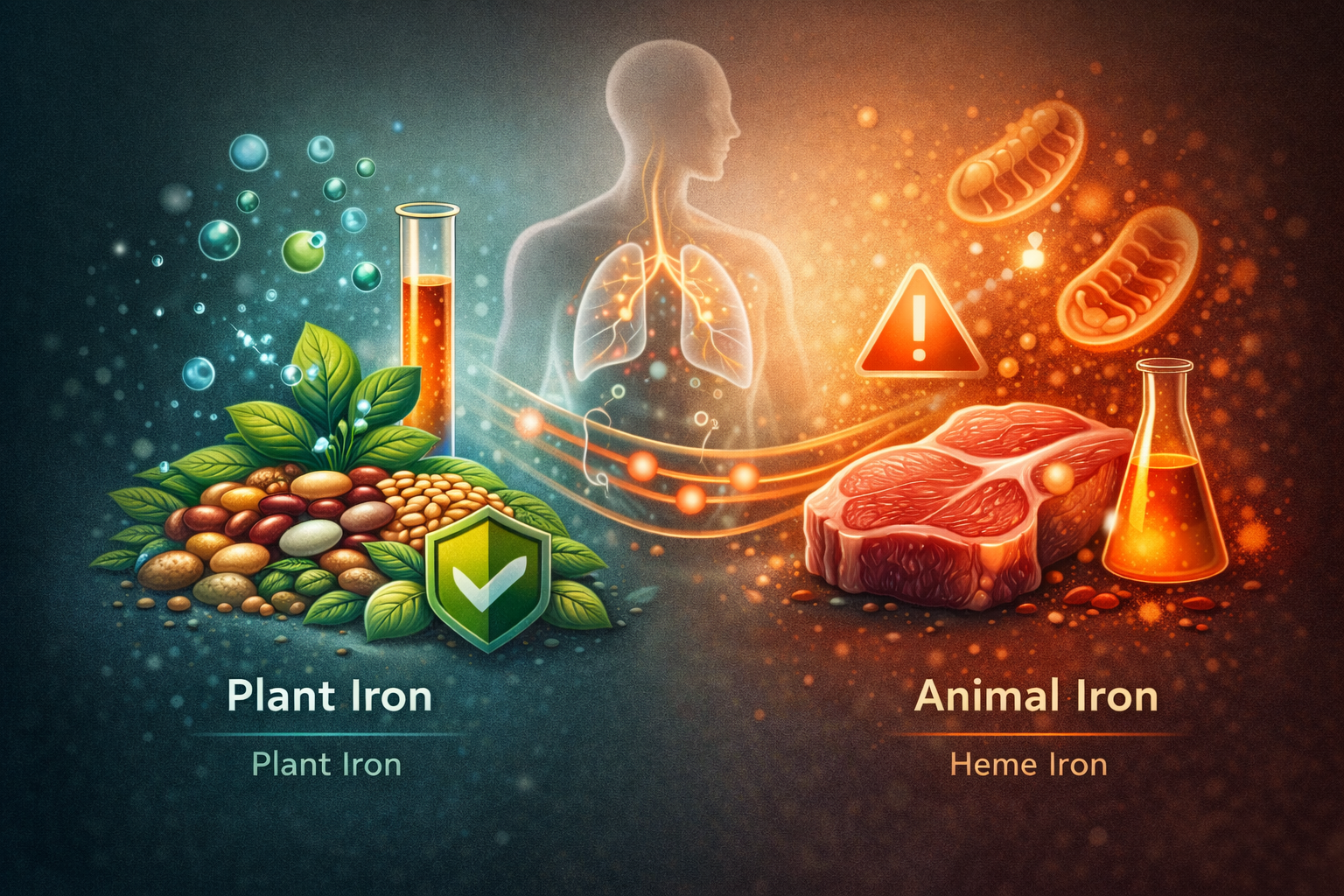
Dietary iron enters the body in two fundamentally different forms, and they behave nothing alike.
Plant Iron (Non-Heme Iron)
Non-heme iron is found in beans, lentils, whole grains, leafy greens, and seeds.
Its absorption is slow and conditional. Uptake depends on digestive capacity, food preparation, gut health, microbial activity, and overall mineral balance.
This is often framed as inefficiency.
In reality, it’s control.
Heme Iron (Animal Iron)
Heme iron is found in red meat, organ meats, and processed meats.
It is absorbed rapidly and efficiently, often bypassing the body’s normal regulatory checkpoints. This can be useful in acute deficiency.
Over time, however, this efficiency increases the risk of iron accumulation—especially in inflamed or compromised systems.
What looks like strength in the short term can quietly become liability over the long term.
Why This Matters for Fitness Adaptation
Cardiovascular fitness isn’t built by flooding the system with iron.
It’s built by consistent oxygen delivery without oxidative damage.
Excess iron impairs mitochondrial efficiency, worsens insulin resistance, raises baseline inflammation, and degrades recovery quality.
In other words, iron overload works against the very adaptations endurance training is trying to create.
Sustainable fitness depends on regulated iron availability, not maximal absorption.
Phytates: Iron Regulators, Not Iron Blockers
Phytates are natural compounds found in many plant foods that bind minerals—especially iron.
This binding is often described as “blocking,” but that language is misleading.
Phytates don’t destroy iron.
They don’t remove it from the body.
They hold it temporarily.
By reducing sudden iron spikes and limiting free iron exposure, phytates act as iron gatekeepers. They delay absorption, reduce oxidative stress, limit iron availability to pathogens, and allow gradual release when conditions are appropriate.
This transforms iron from a metabolic shock into a timed-release nutrient.
The Missing Piece: Phytase
Here’s what most iron discussions leave out.
Humans don’t meaningfully produce the enzyme needed to break down phytates. That enzyme—phytase—comes from three places:
The plant itself, activated through soaking and sprouting.
Fermentation microbes like yeast and lactobacillus.
Gut bacteria within a healthy, diverse microbiome.
When phytase is present, phytates are broken down step-by-step and minerals are released, not lost.
When phytase is absent, minerals remain bound longer than intended.
This is why preparation and gut health—not the compound itself—determine the outcome.
Why Anemia Exists in a Meat-Heavy Culture
Here’s an uncomfortable observation.
Iron deficiency and anemia are common—even in populations that consume large amounts of meat.
That tells us intake alone isn’t the issue.
Contributing factors often include poor digestion, chronic inflammation, parasitic burden, microbial imbalance, and impaired iron recycling.
Parasites and pathogens require iron to replicate. When excess free iron is available, they thrive.
Phytate-rich, plant-forward diets create an iron-restricted environment that favors the host over invaders—a concept known as nutritional immunity.
Iron isn’t eliminated.
It’s protected.
Phytates, Parasites, and Internal Terrain
Parasites rarely enter modern fitness conversations, yet they’re deeply intertwined with iron metabolism, fatigue, anemia, poor recovery, and stubborn inflammation.
By limiting iron access to parasites, reducing pathogen growth pressure, and protecting host tissues from iron-driven damage, phytates quietly shift the terrain.
It’s not surprising that compounds performing this role are labeled “anti-nutrients” by organisms that benefit from unchecked mineral availability.
When Phytates Feel Like the Problem
Phytates tend to cause issues when buffering systems are already compromised—when food is unprepared, the microbiome is weak, mineral status is poor, digestion is impaired, or inflammation is high.
In those conditions, regulation feels like restriction.
The compound gets blamed, but the system is already struggling.
The Index Position
Phytates don’t cause iron deficiency.
They prevent iron excess.
They protect mitochondria, oxygen delivery systems, metabolic efficiency, and long-term cardiovascular adaptation.
For endurance, recovery, and sustainable fitness, regulated iron beats rapid iron every time.
The Final Word
Iron is essential.
Iron excess is destructive.
Phytates exist to manage that tension.
In a body built on real food, proper preparation, and daily movement, phytates don’t block progress—they protect it.
And protection is what allows adaptation to last.