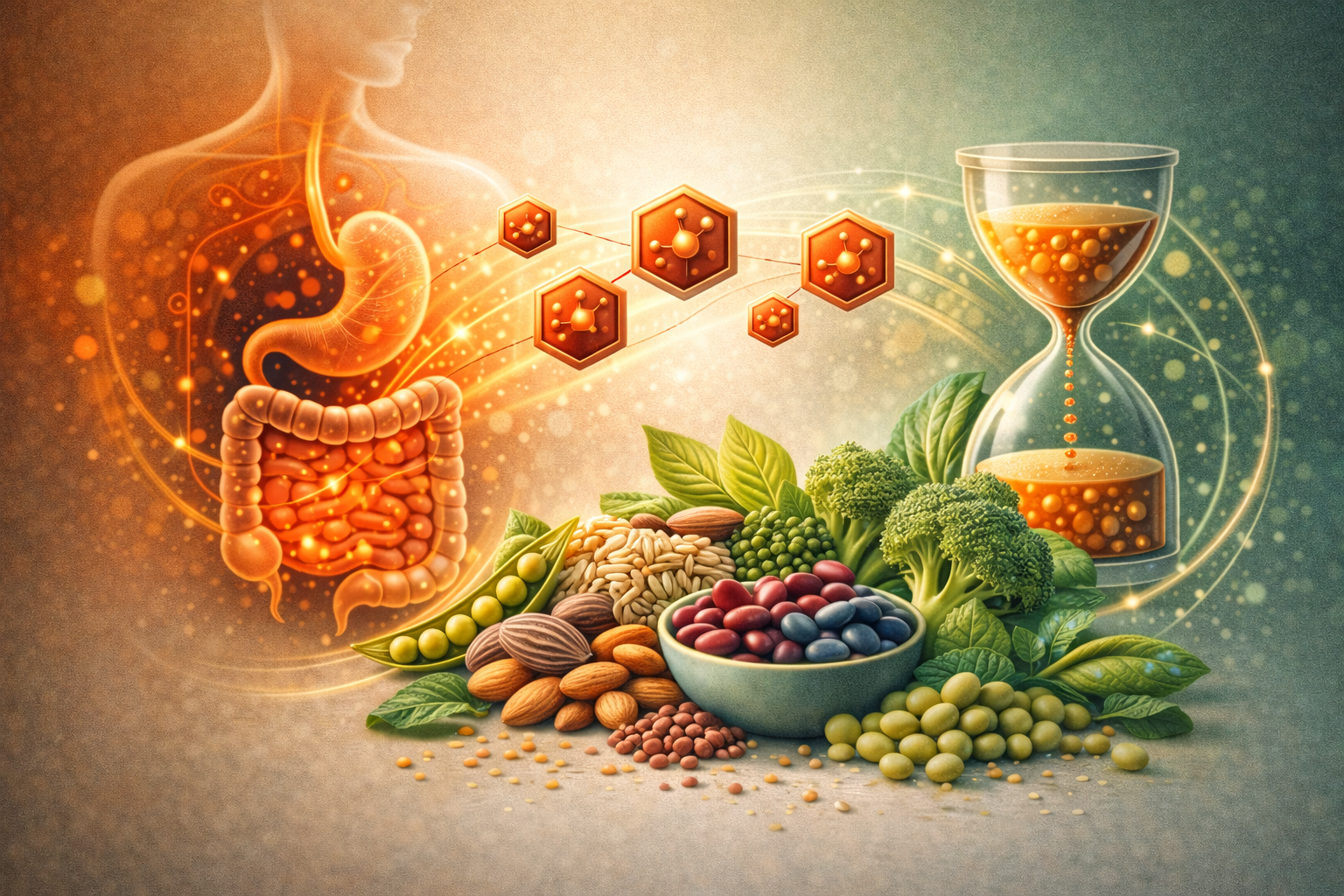
Why slowing protein digestion protects tissue, immunity, and long-term resilience
Protease inhibitors are usually introduced as a problem.
They’re said to block digestion.
Reduce protein absorption.
Stress the pancreas.
And on the surface, that sounds reasonable. Why would the body benefit from anything that slows protein breakdown?
But that question assumes digestion works best when it’s maximized.
Biology rarely agrees.
What Protease Inhibitors Actually Are
Protease inhibitors are naturally occurring compounds found in many plant foods, especially legumes, seeds, and some grains.
Their defining feature is simple: they reduce the activity of protease enzymes—the enzymes responsible for breaking proteins into amino acids.
That reduction is often framed as interference.
In reality, it’s pacing.
Protease inhibitors don’t shut digestion down. They modulate the rate at which protein is broken apart and presented to the gut.
And rate matters.
Digestion Is Not a Race
Efficient digestion isn’t about breaking food down as fast as possible.
It’s about coordinating breakdown with:
- enzyme availability
- tissue tolerance
- immune readiness
- microbial activity
When protein digestion happens too rapidly, large amounts of reactive peptides can appear at the gut surface all at once. That increases the likelihood of irritation, immune activation, and tissue stress—especially in compromised systems.
Protease inhibitors soften that surge.
They slow exposure.
Why Slowing Protein Breakdown Can Be Protective
Protein is powerful.
It stimulates growth, repair, immune activity, and hormonal signaling. But protein breakdown products are also biologically active, and in excess or at the wrong time, they can provoke inflammation rather than support recovery.
Protease inhibitors act like a buffer.
By slightly slowing enzymatic activity, they reduce sudden protein spikes, protect the gut lining from excessive proteolytic exposure, and allow digestion to proceed in a more measured, coordinated way.
This is especially important at the gut barrier, where immune cells are constantly sampling what passes through.
Protease Inhibitors and Immune Tolerance
The gut is not just a digestive organ.
It’s an immune organ.
A significant portion of immune activity occurs at the gut lining, where the body must constantly decide what is food, what is harmless, and what is a threat.
When protein fragments arrive too quickly or in overwhelming amounts, immune surveillance becomes reactive.
Protease inhibitors help regulate that exposure.
They reduce the likelihood that digestion itself becomes an immune stressor, supporting tolerance rather than alarm.
Why Protease Inhibitors Feel Like a Problem
Protease inhibitors tend to be blamed when digestive systems are already strained.
Low stomach acid.
Inflamed gut lining.
Poor enzyme coordination.
Chronic stress suppressing digestion.
In those states, any signal that slows digestion can feel uncomfortable. Bloating, heaviness, or delayed emptying may appear.
But again, the compound didn’t create the weakness.
It exposed it.
When the system lacks flexibility, regulation feels like restriction.
Traditional Preparation Was Never About Elimination
Across cultures, humans soaked, sprouted, fermented, and cooked protease-inhibitor-containing foods.
These practices didn’t remove protease inhibitors entirely.
They softened their effect.
That’s an important distinction.
If protease inhibitors were purely harmful, traditional diets would have eliminated them completely. Instead, cultures learned how to tune the signal—reducing friction while preserving regulation.
Cooking reduces intensity.
Fermentation improves coordination.
Whole meals provide context.
Again, partnership—not eradication.
The Familiar Pattern
Protease inhibitors follow the same pattern seen with every other so-called anti-nutrient.
Phytates pace minerals.
Lectins pace carbohydrates.
Fiber regulates transit.
Tannins manage protein interaction at surfaces.
Goitrogens pace hormonal signaling.
None of these exist to nourish directly.
They exist to regulate exposure.
Protease inhibitors do that at the level of digestion itself.
Why This Matters for How the Body Adapts to Training
Understanding protease inhibitors isn’t just about digestion.
It’s about what kind of adaptation you’re trying to build.
Most fitness systems are built around intensity — pushing hard, breaking tissue down, and relying on aggressive recovery signals to rebuild it. In that context, fast protein digestion and strong anabolic spikes are often treated as the goal.
But that isn’t the only way bodies adapt.
And it isn’t the way adaptation becomes sustainable.
Daily, repeatable training depends less on spikes and more on coordination — between digestion, circulation, connective tissue, immune signaling, and recovery. When protein digestion happens too quickly, it can create unnecessary noise in that system: sharper inflammatory responses, heavier digestive load, and recovery signals that overshoot what the tissue actually needs.
Protease inhibitors quietly reduce that noise.
By slowing the rate at which protein is broken down, they help smooth amino acid availability, lower digestive stress, and keep immune activation proportional. That makes recovery feel cleaner — not because less repair is happening, but because repair is happening without excess.
This matters for joints and connective tissue as much as muscle. Tendons, fascia, and joint capsules adapt slowly. They don’t respond well to repeated inflammatory spikes or erratic repair signals. Protease inhibitors help protect those tissues indirectly by preventing digestion itself from becoming a stressor that bleeds into training.
For systems built around frequent movement rather than occasional overload, this kind of pacing is an advantage. It allows protein to support maintenance, repair, and endurance adaptations without forcing the body into a constant “rebuild at all costs” mode.
In practical terms, this is why plant-forward diets often support daily training better than expected — not because protein is absent, but because its signaling is calmer, longer-lasting, and better matched to steady work.
Protease inhibitors don’t make protein weaker.
They make adaptation quieter.
And quiet adaptation is what allows you to train again tomorrow.
The Index Position
Protease inhibitors are not digestive toxins.
They are digestive-pacing compounds.
They help:
- slow excessive protein breakdown
- protect gut tissue
- reduce immune overactivation
- support long-term digestive resilience
They don’t block nutrition.
They prevent digestion from becoming destructive.
The Final Word
Digestion doesn’t need to be forced.
It needs to be coordinated.
Protease inhibitors don’t weaken healthy systems. They protect them from excess, speed, and strain.
Once again, the issue isn’t plants.
It’s broken context.