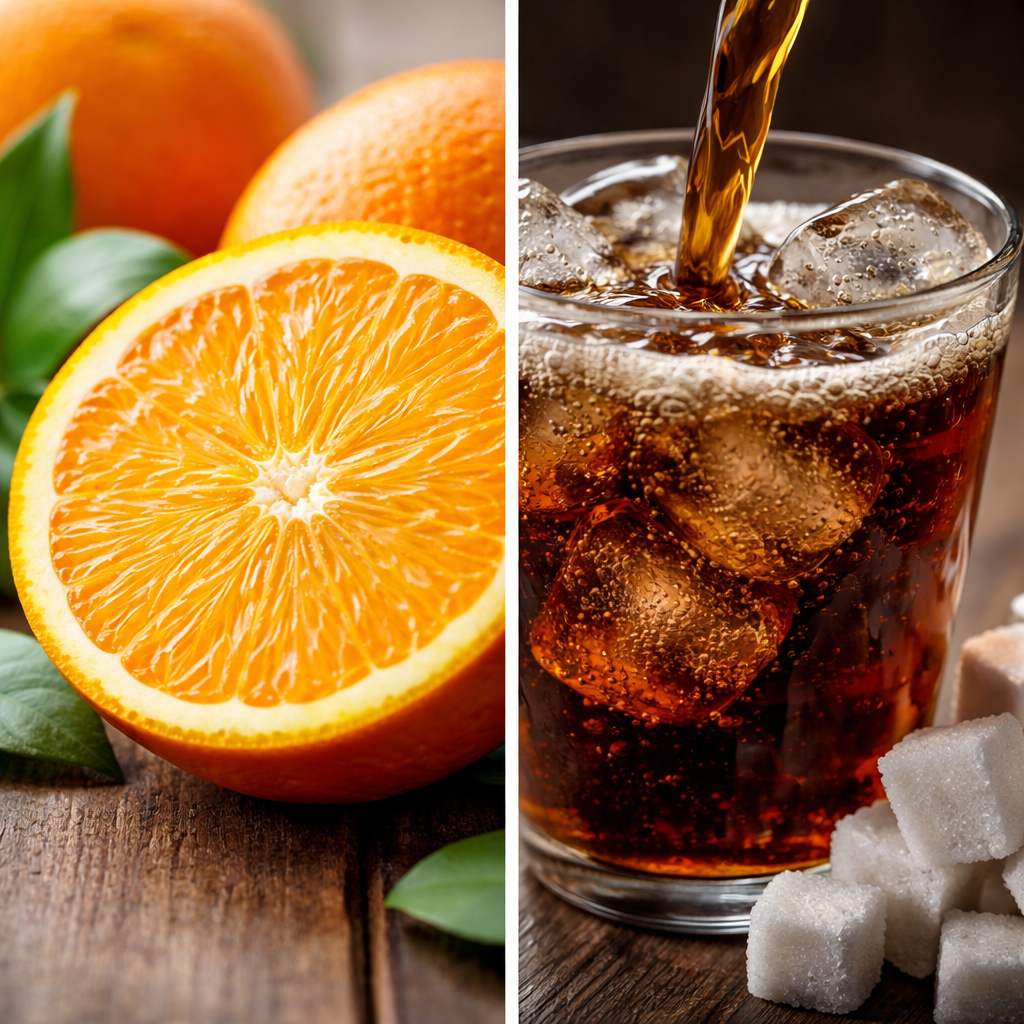
Why Fruit and High-Fructose Corn Syrup Are Not Metabolically Equal
Somewhere along the way, nutrition got reduced to chemistry class.
You’ve probably heard it:
“High-fructose corn syrup is the same as fruit sugar. The body doesn’t know the difference.”
On paper, that sounds scientific.
In reality, it’s incomplete.
Because the body doesn’t experience nutrients as isolated molecules.
It experiences them as events.
And fruit and soda are not the same metabolic event.
The Two Pathways of Sugar (That Rarely Get Explained Properly)
Let’s slow this down.
There are two main sugars involved here:
- Glucose
- Fructose
They are handled differently in the body.
That’s not opinion. That’s physiology.
Glucose → Pancreas → Insulin → Body
When glucose enters your bloodstream:
- Blood sugar rises.
- The pancreas senses it.
- Insulin is released.
- Insulin allows glucose to enter muscle, fat, and other tissues.
This is where the phrase “insulin spike” comes from.
And yes — large, rapid glucose loads can create large insulin responses.
But here’s what often gets missed:
Insulin is not the villain.
It is a regulatory hormone.
The issue isn’t that insulin rises.
The issue is when it rises:
- Too high
- Too often
- Too quickly
- In an inflamed, sedentary system
That’s a context problem — not a molecule problem.
Fructose → Liver → Glycogen (Primarily)
Fructose behaves differently.
It does not require insulin to enter cells.
It is transported primarily to the liver, where it is:
- Converted into liver glycogen (if storage is available)
- Used in small amounts for energy
- Converted into fat only when the liver is already overloaded
Notice something important here:
Fructose does not create the same immediate insulin response that glucose does.
This is where some people say:
“It bypasses the pancreas.”
That’s partially true.
But what matters is not whether it bypasses insulin —
what matters is whether it overloads the liver.
And that depends entirely on delivery.
Here’s Where the “Same Sugar” Argument Falls Apart
Yes, high-fructose corn syrup contains glucose and fructose.
Yes, fruit contains glucose and fructose.
But fruit also contains:
- Fiber
- Water
- Micronutrients
- Phytonutrients
- A structural matrix that slows digestion
Soda contains none of those.
The difference is not the molecule.
The difference is how fast and how concentrated that molecule hits your system.
What an “Insulin Spike” Really Means
“Insulin spike” has become a fear word.
But insulin rises in response to:
- Bread
- Potatoes
- Rice
- Fruit
- Even protein
The problem is not the spike itself.
The problem is chronic metabolic stress combined with repeated rapid glucose delivery.
Whole fruit:
- Slows absorption through fiber
- Requires chewing (which slows intake)
- Contains water (diluting sugar concentration)
- Delivers glucose gradually
- Keeps insulin demand moderate
Soda:
- Requires no chewing
- Empties from the stomach rapidly
- Hits the bloodstream quickly
- Forces a rapid insulin response
- Often in a sedentary environment
That’s not the same experience.
Not hormonally.
Not metabolically.
Not behaviorally.
The Liver Is the Real Judge
The liver is the metabolic referee.
If liver glycogen is low:
- Fructose is stored safely.
- Stress hormones drop.
- Glucose dumping overnight decreases.
If the liver is already full:
- Rapid fructose delivery contributes to fat synthesis.
- Insulin resistance increases.
Fruit rarely overwhelms a functioning liver.
Processed sugar routinely can.
Because volume + speed + context matter.
Fiber Changes the Game
Fiber isn’t decoration.
It:
- Slows glucose entry
- Feeds gut bacteria
- Produces short-chain fatty acids
- Improves insulin receptor sensitivity
- Reduces inflammation
When you remove fiber (juice, syrup, refined sugar), you remove the buffering system.
Now you’re delivering pure carbohydrate velocity.
That’s what the body reacts to.
Water Matters More Than People Think
Whole fruit is mostly water.
Water:
- Slows gastric emptying
- Reduces sugar concentration per bite
- Improves circulation
- Enhances glucose delivery efficiency
A soda is hyper-concentrated sugar.
An orange is structured hydration with carbohydrate embedded inside it.
Those are not metabolically identical.
Micronutrients & Phytonutrients: The Silent Difference
Fruit is loaded with compounds that:
- Improve endothelial function
- Reduce oxidative stress
- Enhance insulin signaling
- Improve vascular flexibility
Processed sugar provides energy without support.
Fruit provides energy with regulation.
If They Were the Same, Outcomes Would Match
This is the simplest test.
Do populations develop metabolic disease from whole fruit the way they do from ultra-processed sugar?
No.
If the body “didn’t know the difference,” outcomes would be indistinguishable.
They are not.
Because biology is not chemistry in isolation.
It is chemistry in context.
The Fitness Index Position
Metabolic dysfunction develops from:
- Chronic caloric excess
- Sedentary living
- Inflammatory diets
- Stress hormones
- Poor sleep
- Repeated rapid glucose delivery without demand
Whole fruit rarely creates that environment.
Ultra-processed sugar often does.
The Final Word
Fruit is not candy.
Fruit juice is not fruit.
Delivery matters.
Speed matters.
Context matters.
Movement matters.
The body absolutely knows the difference.
And if you’re training daily, circulating blood, refilling glycogen, and eating whole foods — fruit behaves like fuel.
Not like poison.