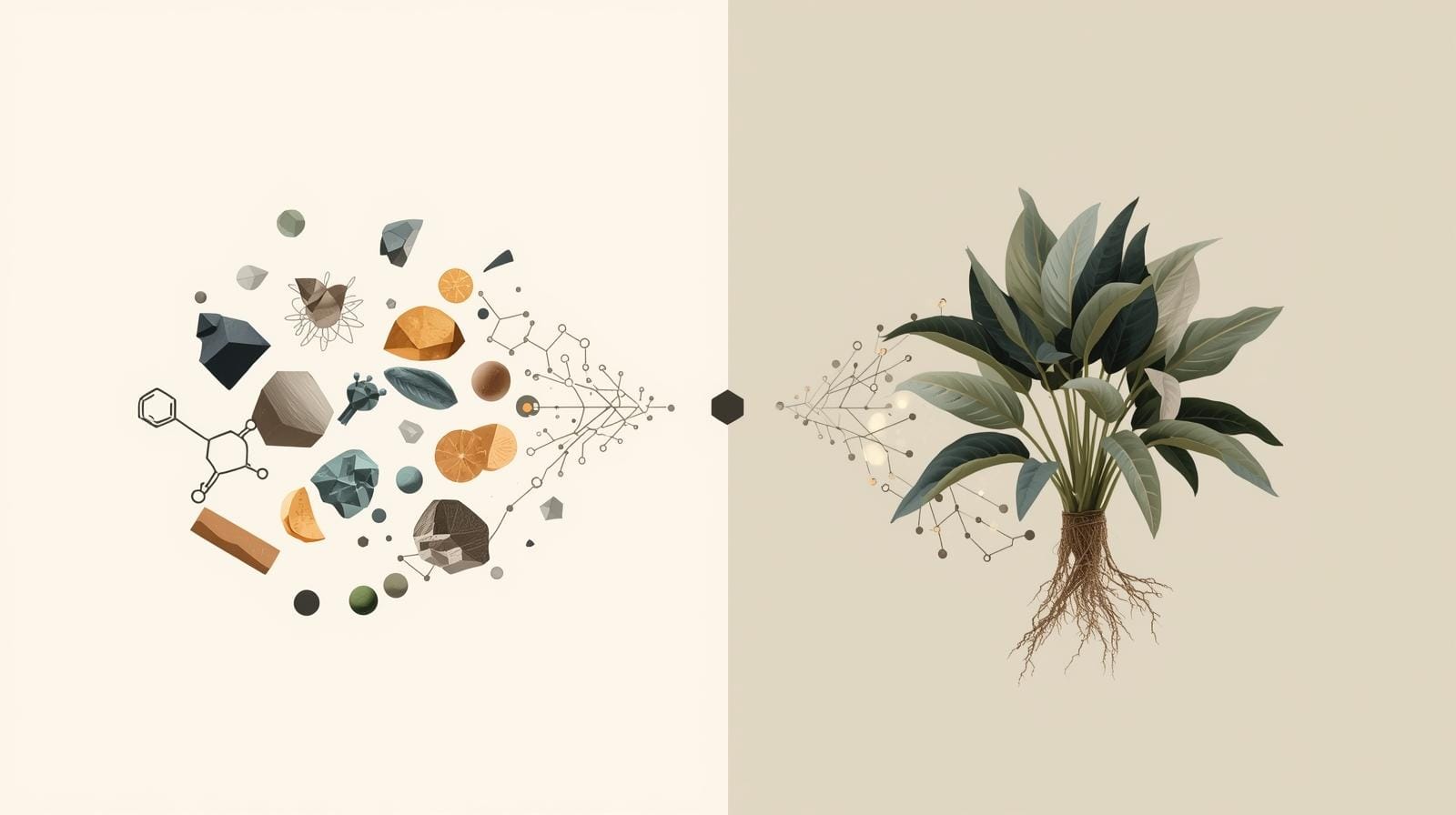
The difference between treatment-based thinking and biological support
Modern health culture is obsessed with fixing problems.
Low calcium? Add calcium.
Low iron? Take iron.
Low energy? Try B vitamins.
Poor immunity? Stack supplements.
This approach feels logical — even scientific.
But it’s built on a flawed assumption:
That nutrients work best when isolated.
The body disagrees.
The Body Is Not Built for Free Chemistry
In nature, nutrients never arrive alone.
They come packaged inside whole foods, bound to fibers, minerals, enzymes, water, and signaling compounds that control how fast they enter the system and where they go.
When we isolate chemistry — vitamins, minerals, amino acids — we remove that control.
To the body, this often looks less like nourishment and more like pressure.
Isolation Changes How the Body Responds
Isolated nutrients tend to:
- Absorb faster
- Accumulate more easily
- Bypass natural regulatory checkpoints
- Create downstream antagonisms
The body then has to fix the imbalance created by the treatment.
That repair effort costs energy, minerals, hormones, and time.
This is why people often feel a short-term boost…
followed by new symptoms they didn’t have before.
Examples the Body Knows All Too Well
The body is very good at maintaining balance — but only when nutrients arrive the way biology expects them to.
Problems start when chemistry is isolated, concentrated, and pushed without context.
Take calcium, for example.
Calcium is essential for bone health, nerve signaling, and muscle contraction. But it is also highly excitatory. In the body, calcium needs to be tightly controlled. When calcium is isolated and overconsumed, the body has to buffer it using magnesium. Over time, magnesium reserves drop, muscles tighten, sleep quality suffers, and the thyroid–parathyroid axis is forced to work overtime just to keep blood calcium stable.
The issue wasn’t calcium.
It was calcium without its partners.
Iron is another clear example.
Iron is critical for oxygen transport and energy production. But free iron is also one of the most oxidative substances in human biology. When iron accumulates beyond what the body can safely bind and regulate, it accelerates oxidative stress, damages mitochondrial membranes, and increases inflammatory load. The body has no active way to excrete excess iron — which is why regulation, not maximization, matters so much.
Iron wasn’t harmful.
Unregulated iron was.
Zinc tells a similar story.
Zinc is widely promoted for immunity, hormones, and recovery. But when zinc is pushed aggressively in isolation, it suppresses copper absorption. Copper is required for antioxidant defense, iron metabolism, and immune coordination. Over time, people can develop fatigue, anemia-like symptoms, and weakened immunity — even though they’re “doing the right thing” by supplementing.
Zinc didn’t fail.
The balance did.
Vitamin D is often treated as a miracle nutrient, but it’s really a signaling hormone. Its job is to increase calcium absorption and direct calcium traffic. When vitamin D is megadosed without adequate magnesium and vitamin K2, calcium absorption rises faster than the body can manage. Calcium ends up deposited in soft tissue instead of bone, and regulatory systems are strained trying to compensate.
Vitamin D wasn’t the problem.
Context was missing.
Even vitamin C, often viewed as harmless, behaves differently when isolated.
In whole fruit, vitamin C arrives with water, potassium, fiber, enzymes, and bioflavonoids that slow its entry and guide its use. In high-dose isolated form, it enters rapidly, competes with other minerals, alters redox balance, and in some people contributes to oxalate load or digestive irritation.
Same molecule.
Completely different biological experience.
This is the pattern that repeats over and over.
None of these nutrients are bad.
None of them are toxic by nature.
They became problematic because they were removed from their natural chemical relationships.
The body doesn’t struggle with nutrition.
It struggles with free chemistry.
This Is the Difference Between Treatment and Support
Treatment-based thinking asks:
“What can I add to fix this symptom?”
Biological support asks:
“What system is out of balance — and why?”
You cannot diagnose deficiency or disease accurately until digestion, absorption, utilization, and elimination are functioning.
Most people don’t have a shortage problem.
They have a processing problem.
From Isolated Chemistry to Intelligent Regulation
If isolated nutrients create imbalance, the obvious question becomes:
What prevents that imbalance in nature?
Plants don’t deliver nutrition as free-floating chemistry.
They deliver it as systems.
Every plant contains compounds that:
- slow absorption when speed would cause harm
- bind minerals when excess would overwhelm tissues
- pace digestion so signaling stays coordinated
- protect against oxidative overload
- train the body instead of overwhelming it
These compounds have been mislabeled as “anti-nutrients.”
In reality, they are regulatory compounds.
They don’t block nutrition.
They teach the body how to handle it.
Oxalates regulate minerals.
Lectins regulate sugar entry.
Phytates regulate iron and oxygen load.
Tannins regulate protein interaction.
Saponins regulate cholesterol and terrain.
Goitrogens regulate metabolic speed.
Fiber regulates timing and movement.
Protease inhibitors regulate protein pacing.
Together, they form something far more intelligent than isolated supplementation.
They form a Plant Regulatory Network — a biological system designed to prevent excess before damage occurs.
That system is the opposite of treatment-based thinking.
It is preventative by design.
And it’s the missing layer in modern nutrition.
→ Read next: The Plant Regulatory Network: Why Plants Regulate What Supplements Isolate
The Fitness Index Perspective
Supplements and drugs are sometimes necessary.
But they are interventions, not foundations.
The goal is not to treat endlessly.
It is to restore capacity so treatment becomes unnecessary.
When digestion, circulation, lymphatic flow, and elimination are supported:
- The body rebalances chemistry on its own
- Tolerance expands
- Symptoms resolve without force
That is health.
The Final Word
You can’t isolate chemistry out of chemistry and expect improvement.
The body doesn’t thrive on concentration.
It thrives on coordination.
Plants don’t overwhelm the system.
They train it.
And that distinction is the difference between chasing symptoms —
and building health that lasts.