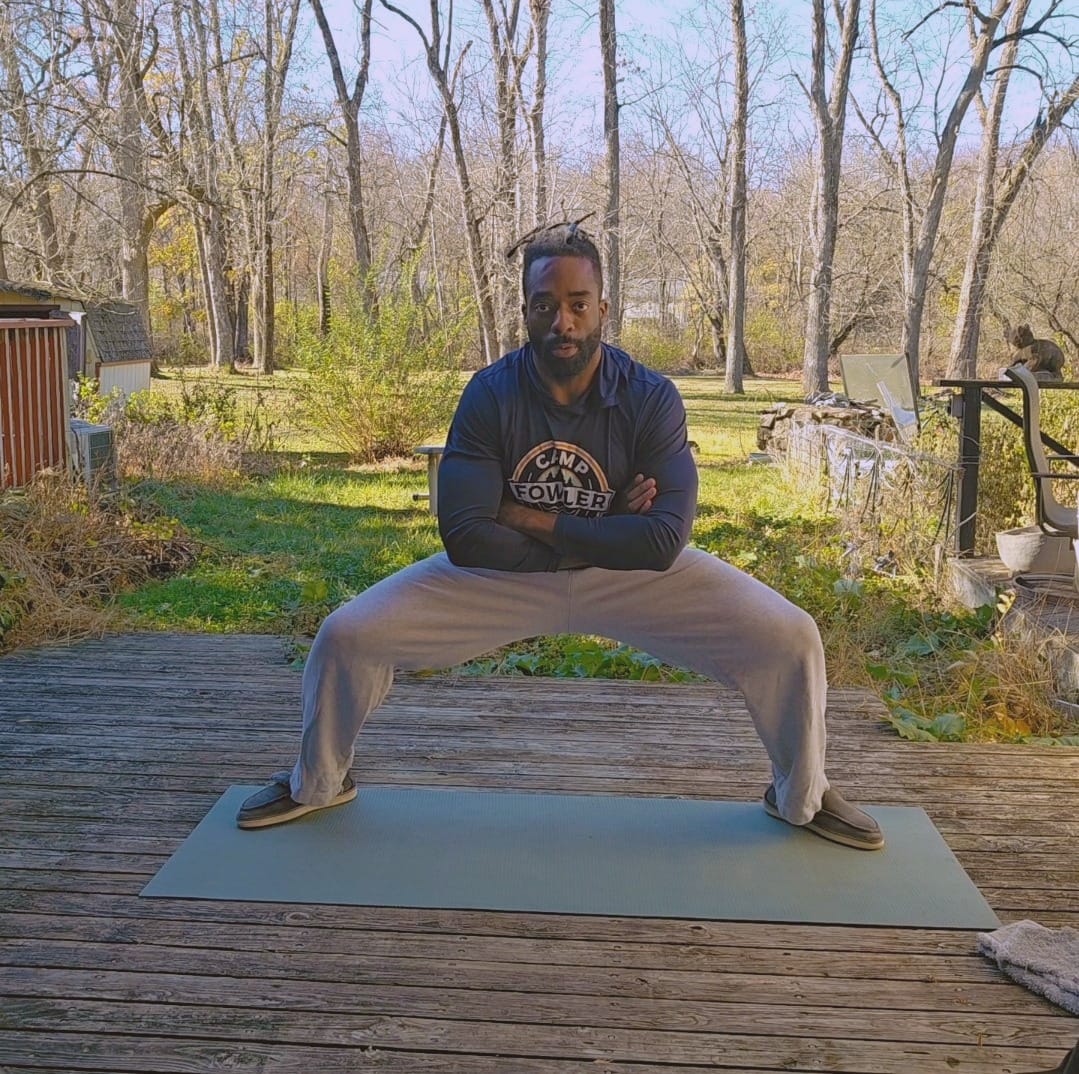
Most people who try horse stance for the first time expect it to be the easy part of the routine. Nothing is moving, nobody is counting reps, and from across the room it looks like someone waiting on a bus. Then about twenty breaths in, the thighs start shaking, the knees want to cave toward each other, and the hips keep sneaking up an inch looking for relief.
That shake is the point. A stance looks still, but the body inside it is working the entire time to keep gravity from folding the knees and hips. And the research on that kind of work says something most programs skip right over. Holding a position under load trains the tissue that carries force, not just the muscle that makes it.
When I trained with Master Shin in February 2016, there were no kicks and no punches. For 23 days the work was static stretches, isometric holds and long, sustained movement patterns, and horse stance was part of it. We kept exploring it long after those 23 days were over. Stillness was the training, not the warm-up before it. (More on what that lineage builds in Layer on Layer: The Hypertrophy Tradition the Gym Model Forgot.) Horse stance comes out of a Kung Fu tradition where it has been a foundation for a very long time. The science is finally catching up to why.
Holding is not the same as pushing
Exercise researchers split isometrics into two kinds. In a pushing isometric you press into something that won't move, like a bar bolted to a rack. In a holding isometric, sometimes called yielding, a load is trying to move you and your job is to not let it. Horse stance is the second kind. Gravity pulls you down for every second of it, and your legs keep the joints at the angle you chose.
They feel similar. They don't behave the same. In a 2017 experiment, Schaefer and Bittmann had people work at the same high effort and found they could keep up the pushing task longer than the holding one. Same effort, same stillness from the outside, and the body treated them as two different jobs.
That's a good reason to treat a hold as its own kind of training rather than a lazy version of a rep. It also means horse stance isn't the same thing as pressing into a wall, even though both look like standing still.
Time under tension reaches the tendon
Tendons connect muscle to bone. Running through the thigh there are also broad sheets of tendon called aponeuroses that carry the quad's force down toward the knee. Every second you hold a stance, that force is running through those tissues.
Keitaro Kubo's group in Japan tested whether the length of a contraction changes how those tissues adapt. Each person trained one leg with quick one-second contractions and the other with twenty-second holds, at the same effort and the same total work. After twelve weeks both legs were stronger and bigger, but only the long-hold leg came out with stiffer tendon and aponeurosis. Stiff sounds like a bad word. Here it isn't. It means the tissue resists stretching under force, which is part of how cleanly force gets from muscle to bone.
A later Kubo study used isometric squat holds, fifteen seconds each, ten per session, for twelve weeks. That's about as close to stance work as a lab gets. The tendon tissue along the outer quad got stiffer, the quads got stronger, and jumping from a squat improved. The patellar tendon itself didn't change in that study, and that's worth knowing. One position loads a lot of tissue, and it doesn't all adapt at the same pace.
Quick, explosive work has its place, and every program in these studies made people stronger. A 2018 study by Massey and colleagues found both explosive and sustained training stiffened the patellar tendon. But only the sustained contractions also stiffened the larger tendon and aponeurosis system of the knee extensors. Holding reached something that speed didn't.
Fascia is part of the hold too
Fascia is the connective tissue that wraps and separates your muscles, and the fascia lata wraps the whole thigh. In 2019, Otsuka and colleagues watched it on ultrasound during isometric knee extensions and saw it get stiffer as the quads worked harder. So fascia is in the work while you hold. What years of stance practice does to it long term hasn't been measured yet, and we're not going to pretend that question is settled.
The clock isn't the dose
The biggest review on this comes from Bohm, Mersmann and Arampatzis, who pulled together 27 human tendon studies. How much load the tendon actually saw predicted stiffness changes better than whether the exercise was isometric or anything else. Higher effort drove bigger changes.
That changes how to read a stance. Two people can hold horse stance for the same two minutes and do completely different exercises. A shallow stance held comfortably and a low one where you fight for every breath share a name and not much else. Time on the clock tells you how long you were there. Depth and effort tell you how much load went through the tissue.
My own training shows it. I've held a wall sit for an hour, and I haven't come anywhere near that in horse stance. My best there is about 100 breaths. Same legs doing the holding, two very different exercises. Neither number is the target for you, by the way. Ten good breaths is a real start.
That's why we count stances in breaths. Steady breathing is the check that the position is organized. If you can't keep the breath slow and deep, the stance is lower than you've earned yet.
And tendon is slow tissue. Every result above came from repeated sessions over weeks and months, from people coming back to the load again and again. A brutal stance once a month won't move it. Frequency beats intensity.
How to hold it
Feet wide with the toes turned out a little, and sit your hips down between your feet. Keep your knees tracking over the middle of your foot. Roll the hips forward and stack your spine right on top of them so you aren't leaning forward, and breathe deep into your belly.
Start high enough that you can hold ten slow breaths with the knees steady. When ten gets easy, stay a few breaths longer or sink an inch, but not both on the same day. If a doctor or PT gave you limits on your knees or hips, they set the ceiling on how deep you go, not the floor you start from.
Still, but ready to move
In the martial tradition, rooting was never a contest over who could stand the longest. A stance is a place to move from, strike from and take force from. The tendon research explains one physical piece of that, how the body learns to keep force on without giving way. It doesn't replace the skill. Eventually a good stance has to become movement, which is why ours progresses into a side-to-side rock before it goes anywhere else.
Tonight, before you sit down on the couch, hold horse stance for ten slow breaths. If that's too much, stand a little higher and rest your hands on your thighs.
You are the weight, the machine, and the gym. Become the gym.
Further reading
The studies this piece draws on. Thanks to Dr. David Hastings Lloyd, whose writing on stance research pointed us to several of them.
- Schaefer, L. V., and Bittmann, F. N. (2017). Are there two forms of isometric muscle action? BMC Sports Science, Medicine and Rehabilitation.
- Kubo, K., Kanehisa, H., and Fukunaga, T. (2001). Effects of different duration isometric contractions on tendon elasticity in human quadriceps muscles. The Journal of Physiology.
- Kubo, K., Yata, H., Kanehisa, H., and Fukunaga, T. (2006). Effects of isometric squat training on the tendon stiffness and jump performance. European Journal of Applied Physiology.
- Massey, G. J., et al. (2018). Tendinous tissue adaptation to explosive vs. sustained-contraction strength training. Frontiers in Physiology.
- Otsuka, S., Shan, X., and Kawakami, Y. (2019). Dependence of muscle and deep fascia stiffness on the contraction levels of the quadriceps. Journal of Electromyography and Kinesiology.
- Bohm, S., Mersmann, F., and Arampatzis, A. (2015). Human tendon adaptation in response to mechanical loading. Sports Medicine - Open.