The cuff tightened, the number came back higher than last year, and before you had your sleeve rolled back down you had your instruction. Cut back on the salt.
So you did. You stopped reaching for the shaker. You started reading the back of the soup can. Somebody in your house said dinner tasted like nothing for about four months straight, and you kept going anyway, because you were told this was the lever.
Then you went back. The number had moved a couple of points, or it hadn’t moved at all, and the conversation turned to medication.
I want to be careful here, because your doctor was not wrong to bring up sodium. That advice comes from real evidence and it helps a real group of people. What it doesn’t do is answer the question you actually walked in with, which is how the number got high in the first place. Salt was not what put it there.
What insulin is doing to your kidney
Your kidney is not just a filter. It is a valve, and one of the hormones with a hand on that valve is insulin.
When insulin is high, it tells the kidney to hold onto sodium instead of letting it go out in the urine. This has been measured directly, in people, with insulin infusions and 24-hour urine collections. The effect shows up all along the nephron. Sodium that would have left the body stays in it.
Sodium holds water. Water is volume. Volume inside a fixed set of pipes is pressure.
In other words, the salt you ate is not the issue. The signal telling your body not to let it go is the issue.
In other words, high blood pressure in a lot of people is a downstream reading on a metabolic gauge, not a salt-intake report card.
There is a cruelty built into this. When someone develops insulin resistance, the muscles stop responding to insulin’s message about glucose. The kidney does not stop responding to insulin’s message about sodium. That sodium-holding effect stays intact, and in some people it appears to get stronger. So the body raises insulin to force glucose into tissue that has quit listening, and every unit of that extra insulin lands on a kidney that is still listening perfectly.
The glucose part goes deaf. The sodium part does not.
That is not a salt problem. That is what happens when the gear shift gets stuck in first. Insulin is not the villain. Constant input is.
What happens when you only take the salt away
Sodium restriction does lower blood pressure. That part is real and I am not going to pretend otherwise. In pooled trial data, the drop runs about three and a half percent in people with hypertension and about one percent in people without it.
The same pooled data shows what else moves. Renin, aldosterone, and noradrenaline all climb, and while they do, cholesterol rises roughly two and a half percent and triglycerides rise roughly seven percent.
Read that back slowly. The body responded to the sodium coming out of the diet by turning up the hormones that conserve sodium and raise vascular tone, and the blood lipids got worse while it did.
That is not the body malfunctioning. That is the body defending itself, and doing it well, because sodium is not a contaminant. It is one of the most tightly guarded minerals you carry. Squeeze the supply and you get a stress response, because that is exactly what you would want to happen if food were genuinely scarce.
The body always wins. If you take something it needs, it will go get it, and it will charge you for the trip.
None of that would matter much if the trade were clean. A few points of pressure for a slightly worse lipid panel and a bump in stress hormones might still be worth it. But it is not a clean trade, because the insulin that started the whole sequence is still exactly where it was.
Who actually needs to watch the sodium
This is where I need you to stay honest with your doctor instead of getting clever with an article.
Salt sensitivity is a real and measurable trait. Give a salt load to a room of people and some of their pressures climb sharply while others barely move. The rough estimates put it at around half of people with hypertension and a quarter of people without, and it runs higher in Black adults, in older adults, and in anyone carrying kidney disease, diabetes, or metabolic syndrome.
If you are in that group, sodium is not a side issue for you and the limit you were given is doing work. If you are on a diuretic, on a blood pressure medication, in heart failure, or living with kidney disease, this article is background reading and not a plan. Stay on what you were prescribed. Work with the doctor who knows your labs.
What I am asking you to add is the question nobody asked in that appointment, which is why the pressure went up before anyone ever mentioned a shaker.
Twenty-one thousand people and a different shaker
There is a study I keep coming back to because it tested the thing directly.
Researchers took about 21,000 adults across 600 villages in rural China, all of them either stroke survivors or older adults with uncontrolled blood pressure. Half the villages kept using regular salt. The other half got a substitute that was three-quarters sodium chloride and one-quarter potassium chloride. Then they followed everybody for about five years.
The substitute group had 14 percent fewer strokes, 13 percent fewer major cardiovascular events, and 12 percent fewer deaths.
Nobody took the salt off the table. They changed what was in it. And when researchers went back to work out how much of the benefit came from the sodium going down versus the potassium going up, the analysis pointed at the potassium as the larger contributor.
That is the whole argument in one trial. The number on the shaker mattered less than the balance inside it.
You don’t have a salt problem
You have a potassium problem, and so does almost everybody else.
Somewhere around two to three percent of American adults take in the recommended amount of potassium. Only about one in eight has a sodium-to-potassium ratio under one. And in study after study, that ratio predicts cardiovascular disease and death better than sodium alone or potassium alone.
Now look at where the sodium is actually coming from. Only about a tenth of it is discretionary, meaning the shaker on your table and the salt in your pan. The rest arrives already inside the food, which is why four months of bland eggs moved the needle so little. You were fighting the tenth you could see.
And processed sodium arrives naked. Nothing rides along with it. No potassium to help the kidney let it go, no magnesium, no fiber slowing anything down, no water. It is the mineral pulled out of every context that would have helped your body handle it.
Sodium in real food shows up differently. It comes packaged, in smaller amounts, alongside the minerals that balance it.
Don’t go start counting potassium
I want to head this off, because this is exactly where people go wrong with this information.
The answer is not to download an app and start chasing milligrams of potassium the way you were chasing milligrams of sodium. That is the same anxious behavior wearing a different coat. You would be logging the same way and worrying the same way, just in new units. Plates over numbers, and that rule does not get suspended just because the nutrient in question is one I like.
You do not need to know that a medium sweet potato covers a real share of your day’s potassium. You need to put the sweet potato on the plate.
What the food is actually doing in there
Potassium is not a number on a label. It is doing specific work in your body, and the work is worth knowing.
It helps the kidney let sodium go, which is the direct counter to the signal insulin was sending. It relaxes vascular tone, so the pipe itself is less clenched. Inside the cell, it is one half of the pump that makes every nerve signal and every muscle contraction possible.
The foods carrying it bring more than potassium. Beans and lentils bring fiber that slows the glucose curve, which lowers the insulin response, which turns down the sodium-holding signal at the source. Leafy greens bring magnesium, which the vasculature needs to relax. Avocado, plantain, squash, and sweet potato bring potassium with the water and fiber still attached to it, so the whole package releases slowly instead of dumping.
Every one of those is doing something to the cause, not to the reading. Repair the terrain. Don’t fear the food.
The part the plate can’t do by itself
Food sets the conditions. Movement builds the engine.
When a muscle contracts, it pulls glucose out of your blood without needing insulin to open the door. It has a separate mechanism for that, and it does not care whether the muscle is insulin resistant. So every time you move, you are lowering the amount of insulin your body has to produce to handle the same meal, which means less signal reaching the kidney to hold sodium.
You do not need a gym for that, and you do not need an hour. Thirty minutes a day of bodyweight work, done daily, does more for this than three hard sessions a week does, because the signal you are trying to change is a daily one. Frequency beats intensity.
The vessels themselves adapt to being used, too. You build capillary density and you change how much blood the system can move at a given output, which is the piece nobody mentions in a blood pressure conversation. No circulation, no transformation.
Try this at your next meal
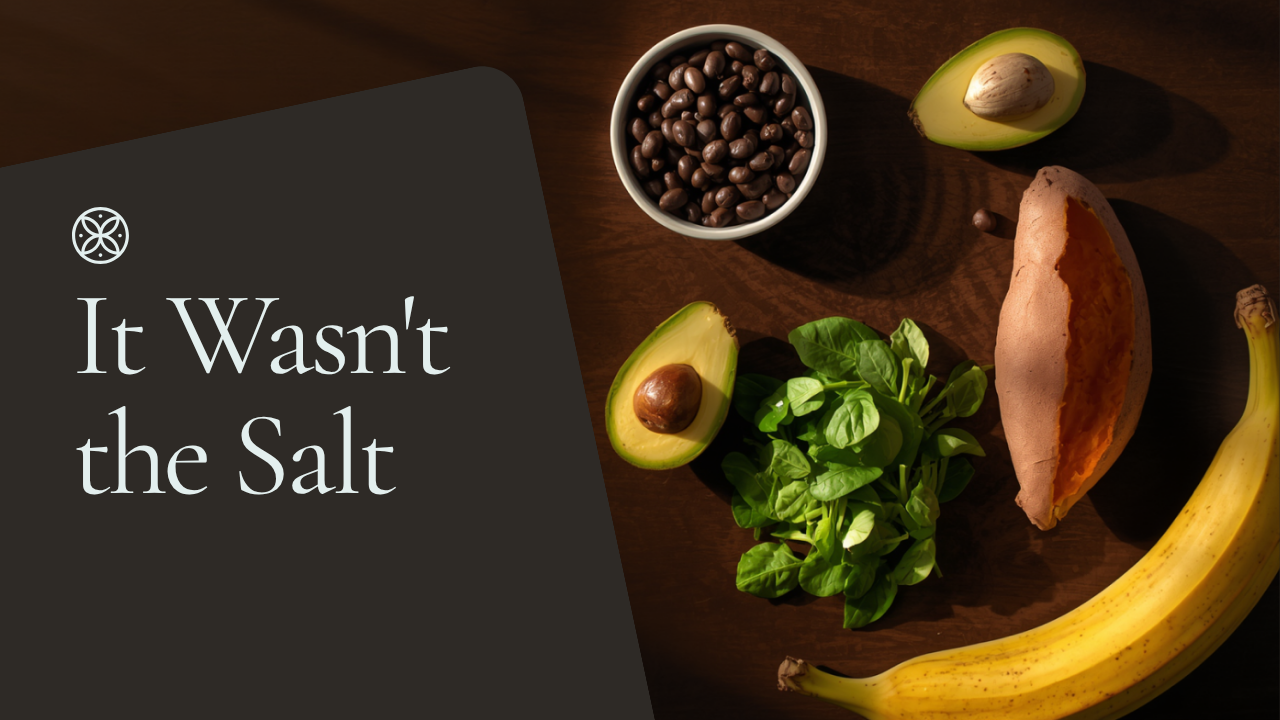
Look at your plate and find the potassium. One bowl of black beans, one baked sweet potato, half an avocado, two cups of sautéed spinach, one grilled plantain. Pick the one that fits what you already cook and put it on there.
Then keep taking your medication, keep the appointment, and bring the reading with you.
Keep going:
- Insulin Resistance Is a Disposal Problem, Not a Carb Problem
- The Roots of Metabolic Dysfunction
- Your Body Has 4 Gears (And Why You’re Stuck in First)
Where this comes from
This piece argues against advice most people got from a doctor, so you should be able to check it rather than take my word for it. Here is what each part of the argument rests on.
That insulin tells the kidney to hold sodium. Sarafidis and Bakris, American Journal of Nephrology, 2007, is the review that lays out the effect and, more importantly, shows it survives in people who are already insulin resistant. Tiwari and colleagues cover which transporters along the nephron insulin is actually acting on.
That cutting sodium raises stress hormones and worsens lipids. Every figure in that section comes from the Cochrane review by Graudal, Hubeck-Graudal and Jürgens, last updated 2017. It pools the randomized trials and reports the blood pressure change alongside renin, aldosterone, catecholamines, cholesterol and triglycerides.
The salt substitute trial. Neal and colleagues, New England Journal of Medicine, 2021. The follow-up modelling is where the reading comes from that potassium carried the larger share of the benefit.
How little potassium people actually get. Cogswell and colleagues on sodium and potassium intake in US adults, and Bailey and colleagues on the sodium-to-potassium ratio and how few people sit below 1.0.
That salt sensitivity is real and affects a specific group. The prevalence figures come from the American Heart Association’s scientific commentary on salt sensitivity of blood pressure.
I am a coach, not a physician, and none of the above changes that. It is here so you can bring a better question to the person who does read your labs.