That moment is where most nutrition plans actually fail. Not at the grocery store. Not at the gym. Not in the app. Right there at the counter, with your hand on the takeout menu, because your brain has run out of bandwidth to make one more decision.
Meal prep isn't about control. It's about moving the decision from 5:47 p.m. on Tuesday to a calmer moment on Sunday when you actually have the capacity to choose well.
The real problem is decision fatigue
Every honest coach will tell you the same thing: the people who fall off a nutrition plan aren't weak. They're tired. They make ten thousand decisions a day — what to wear, what to pack the kids, what to answer in the Slack thread, when to grocery shop, which bill to pay first — and by the time food decisions come up, they're operating on fumes.
When your executive function is drained, you don't pick the grilled chicken and sweet potato. You pick whatever is already decided for you. If that's a pizza delivery app with saved payment info, that's what wins.
The fix isn't more willpower. The fix is better architecture.
You don't have a discipline problem. You have a recovery problem — and decision fatigue is recovery's silent cousin. Meal prep addresses both.
What meal prep actually is (and isn't)
When people hear "meal prep," most of them picture six Tupperware containers stacked in a fridge, each holding exactly six ounces of chicken and a measured half-cup of rice. That image is doing more damage to your nutrition than almost anything else, because it makes meal prep feel like a bodybuilder hobby instead of a parent-survival tool.
Meal prep, done the way I teach it, looks nothing like that. It's usually 30 minutes on a Sunday where you do three things:
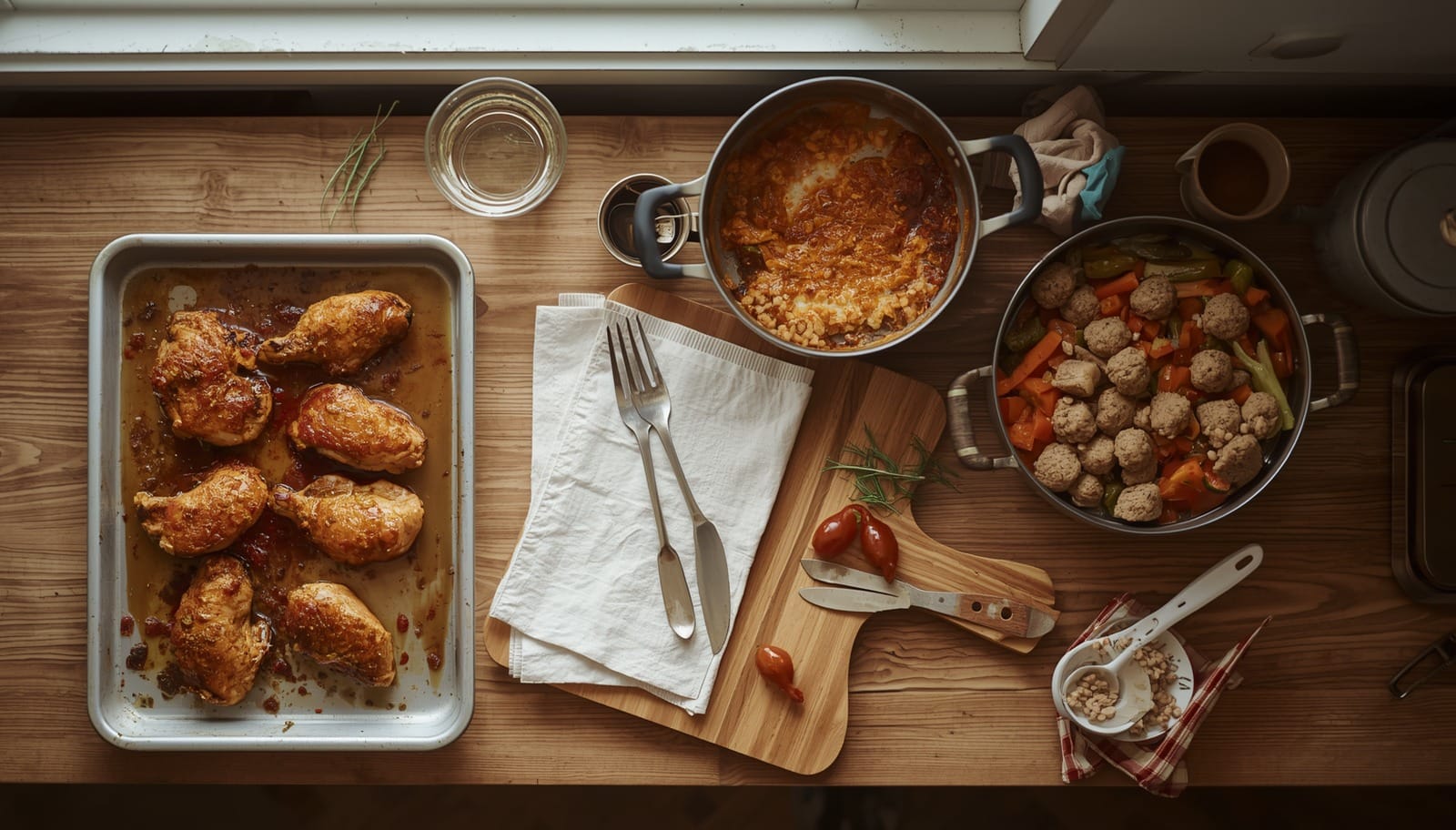
- Cook a protein that'll last the week — a tray of baked chicken thighs, a pot of ground beef, a dozen hard-boiled eggs
- Roast or steam a pile of vegetables that'll pair with most meals
- Cook one starch in volume — rice, sweet potatoes, quinoa, pick one
That's it. You're not assembling meals. You're building a kitchen where good meals can happen in three minutes on a Tuesday night.
The difference matters. Pre-assembled containers feel like a constraint. A stocked kitchen feels like options. One of those stays on your counter for four days. The other disappears by Wednesday.
Why it works when willpower fails
The mechanism here is simple: you remove choice from the moment of low willpower and keep it in the moment of high willpower.
On Sunday afternoon — coffee in hand, kids playing, zero time pressure — you have the cognitive bandwidth to think through the week. What's on the schedule? Which nights are busy? What do you actually want to eat?
On Tuesday at 5:47 p.m., you don't have that bandwidth. You don't need it either. You just need to open a fridge that already has chicken, roasted broccoli, and sweet potatoes ready to combine.
This is why meal prep compounds in a way most nutrition moves don't. You're not forcing yourself to eat better through daily discipline. You're engineering your environment once a week so that eating better is the path of least resistance six days in a row.
The staples connection
Meal prep works best when you're not prepping twelve different meals each week. It works best when you've picked your staples and you rotate through them.
This is where meal prep and dietary staples link together. If you've committed to eight or so real foods as your base, the prep gets boring in the best way. Same proteins. Same vegetables. Same starches. Different combinations, different spices, different days.
Boring is the goal. Variety is what makes people quit — not because they're weak, but because thirty-seven different recipes is thirty-seven different grocery lists and thirty-seven different cook times. Dietary repetition is what lets consistency take over. Meal prep is just the mechanical expression of that idea.
The four pushbacks
I've heard roughly four objections every time I bring meal prep up with a new client.
"I don't have time." You have time for a 30-minute workout but not a 30-minute prep? The prep saves you probably two hours across the week in stopping at the store, figuring out what to cook, and waiting for food to be ready. It's a net time gain after the first Sunday.
"My family won't eat the same thing all week." Then prep the components, not the meals. Everyone in the house can build a different plate off the same three proteins and four vegetables. That's how we run our kitchen.
"I get bored eating the same food." You won't. What boredom actually is is missing the hit of variety — sugar, fat, novelty. After two weeks of repetition, your palate resets and the same foods taste better because you can actually taste them again.
"It's more expensive." It's significantly cheaper. Takeout and grocery-store "convenience" food is where food budgets go to die. A Sunday prep built around eggs, ground beef, chicken thighs, rice, and whatever vegetables are on sale is one of the cheapest ways to eat in America.
What changes after a month
The first week of meal prep feels like an extra chore. The second week, it starts to feel like a system. By the fourth week, skipping it starts to feel wrong, because you've watched what happens to your eating when you skip it.
What you'll notice isn't just the food. It's the mental space that opens up when food decisions stop living in your head. That bandwidth goes back into your kids, your work, your marriage, your training. Meal prep isn't really about food. It's about pulling one heavy tax off your executive function so you can spend it somewhere that matters.
That's why I call it a cheat code. It's not that the food is optimal, or that the timing is perfect, or that you're hitting exact numbers. You're bypassing the part of the day where most nutrition plans collapse — and you're doing it with thirty minutes and a sheet pan.
Plates over numbers. Prep over tracking. That's the whole move.