Why the Answer to a Produce Scare Isn't Less Produce
There's a parasite moving through the produce aisle this summer, and if you've seen the headlines you already know the tone. Cases of cyclosporiasis are climbing across more than a dozen states, with Michigan alone reporting well over a thousand. The bug is a microscopic parasite called Cyclospora, it rides in on fresh produce, and it causes the kind of diarrhea that doesn't quit for days and sometimes comes back in waves for weeks. For a busy parent, that's not a bad afternoon. That's a month of your life gone sideways.
So the advice writes itself, and every outlet is running the same line: be careful with the salad. Some are going further and telling you to think twice about berries, bagged greens, even the caprese with fresh basil. The reflex is fear the food.
I want to give you the honest version, because there's a real thing to do here and there's a deeper thing underneath it, and the news only tells you the first half.
The part they're right about
Handle your produce like it matters, because right now it does.
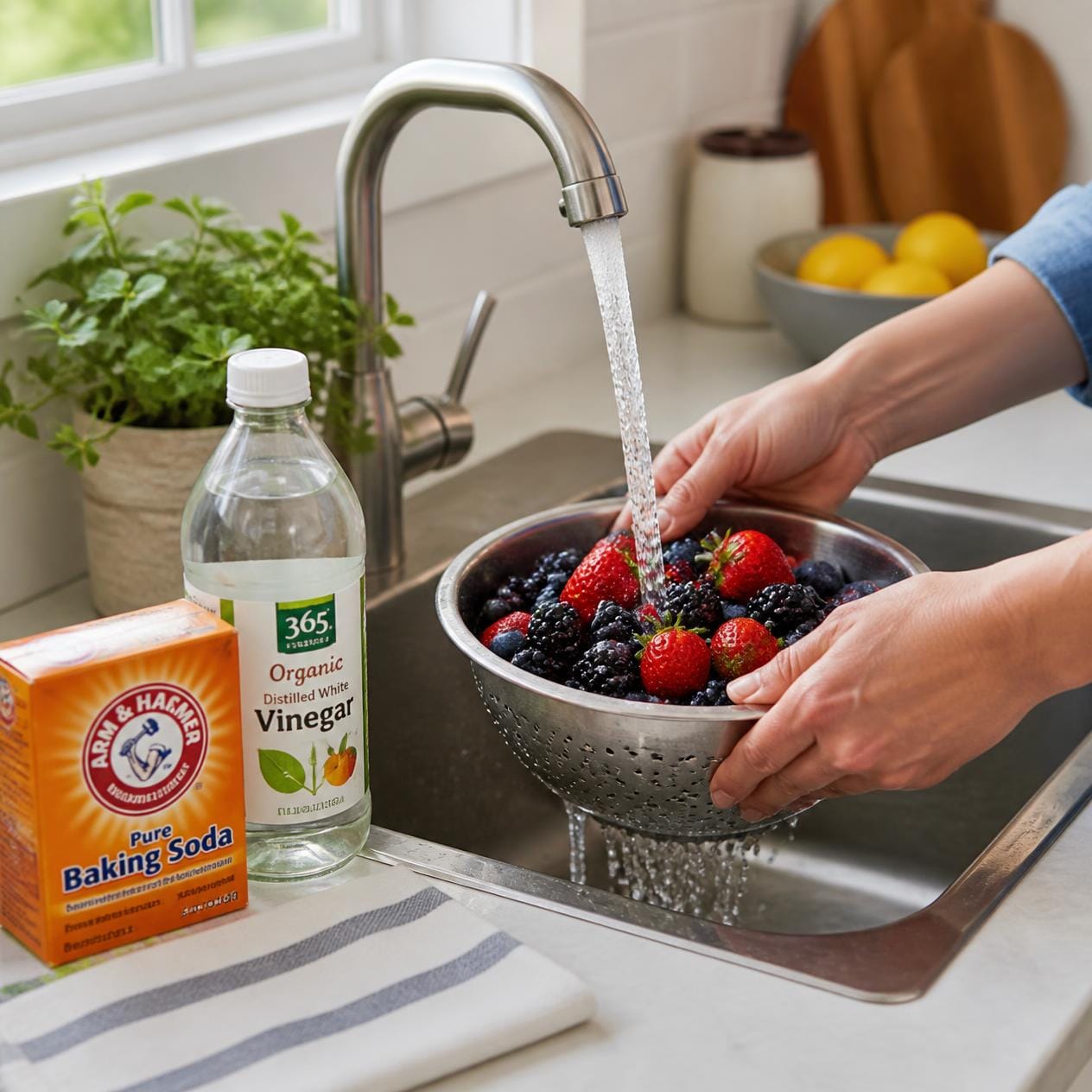
The reason bagged salads and pre-washed mixes keep showing up in these outbreaks isn't bad luck. A bag of cut greens is pooled from a lot of sources, processed in volume, and you can't see into it or scrub it. A whole head of lettuce is a different thing. You can peel off the outer leaves, the ones most likely to be carrying something, and wash what's left under running water. A whole fruit you can scrub. Firm produce takes a soft brush. A rinse with a little vinegar or a baking soda soak pulls off more than plain water does.
None of that is a force field. This particular parasite is sticky and hides in the crevices, so washing lowers your odds without zeroing them out. The only thing that reliably kills it is heat, which is why cooking your produce is the safest play when that option's on the table. But whole food you can inspect and clean beats a sealed bag you're trusting on faith. That alone stacks the odds hard in your favor.
That's the surface move. The one underneath it matters more.
The gut that doesn't flinch
Two people eat off the same contaminated tray at the same cookout. One spends the next three weeks near a bathroom. The other never knows anything happened. That gap isn't luck either.
Your gut isn't a passive tube that food falls through. It's a defended border, run by stomach acid, a dense and varied community of resident microbes, and a lining that stays intact. When that border is in good shape, a lot of what you swallow never gets a foothold. When it's thin and under-populated, the same exposure lands differently. That's the terrain. It's the difference between a gut that's an easy place to move into and one that isn't.
The food fear gets this part backwards. The everyday plate is supposed to be building that border, and the thing building it is the same plant variety people are being scared away from.
What "anti-nutrients" actually are
For a few years now the wellness internet has been telling people to strip certain compounds out of their food. Oxalates in your greens, tannins in your tea and your beans, lectins, phytates, saponins, the bitter and the astringent. The word they use is anti-nutrient, and the story is that these things are working against you.
They're not, and I've laid out why at length before. What gets called an anti-nutrient is really part of a plant regulatory network. These compounds don't strip you of anything. They regulate. They pace how fast nutrients arrive, bind what would otherwise overshoot, and in a few cases make your gut a harder place for something unwelcome to move into. Phytates rein in loose iron and other minerals, which is one of the ways the body keeps a pathogen from finding easy fuel. Saponins interact with cell membranes in a way that weakens invaders and helps keep the terrain clean. Tannins do their part by tightening the gut lining and holding microbial overgrowth in check. Oxalate sits in that same network as a mineral regulator, not a loose weapon. No single one of these does the whole job, and that's the point. They were built to work as a set.
So the protection isn't in any one compound. It's in the full spectrum, eaten together, day after day. A plate with real range on it, the greens and the roots and the alliums and the herbs and the seeds and the bitter things, builds a kind of regulation across your gut that a monotonous, soft, pre-washed diet never does. Strip the plants down to their blandest, most convenient versions and you pull the brakes out of the system along with them. That's the trade almost nobody realizes they're making.
This is Plates Over Numbers wearing its most literal hat. Nobody's counting oxalate milligrams. You eat a wide, colorful, whole-food spread because the variety itself is the regulation.
If it gets you anyway
Terrain is the long game, and no gut is invincible. A big enough dose of a mean enough bug can get past a healthy border, especially if you're older, very young, or your immune system is already carrying a load.
So if you go down with days of diarrhea that isn't letting up, this is not the moment to tough it out with oregano oil and a bottle of something from the supplement aisle. Cyclospora has a specific, effective medication, and a doctor can confirm what you're actually dealing with. Get seen. Take the thing that works. The terrain conversation is about the ninety-nine days you're well, not the one day you need medicine. Both are true at once, and the smart move is to hold both.
That's the whole picture the headlines skip. Wash your food, favor the whole version you can clean over the bag you can't, cook it when the option's there, and keep building the gut that makes all of this a smaller deal in the first place.
Repair the terrain. Don't fear the food.