Real consistency in nutrition doesn't come from restriction — and it doesn't come from chasing variety. It comes from building a short rotation of real foods, drawn from where you are and who you are, that your body learns to expect.
The wellness industry has a favorite word, and that word is variety. Eat the rainbow. Try new recipes. Don't get stuck in a rut. Keep your gut interested. Keep your taste buds excited. The implication is always that sameness is bad and that the more different things you can put on your plate, the healthier you must be.
There's a real principle buried in there. Plant variety builds a richer microbiome. Different foods carry different nutrients. None of that is wrong. But the way the variety message gets sold to the average person has very little to do with feeding a body — and a lot to do with selling them new things to buy.
Walk down a grocery aisle and you'll see what I mean. Eighty different cereals. Forty different protein bars. A hundred different snack packages, each in a different color, each promising to be different from the one next to it. The shelves are exploding with variety. But when you flip the boxes over and read the labels, you're reading the same handful of refined grains, the same seed oils, the same syrups, and the same flavor chemistry rearranged into eighty different costumes.
That isn't variety. That's marketing.
What Real Variety Actually Looks Like
Real variety lives in a much smaller framework than people realize. There are eight categories of real food, and once you understand that, the whole conversation about variety opens up.
Meat. Fish. Fruit. Vegetables. Nuts. Eggs. Salt. Water. That's the entire universe of food the human body was designed to run on. Together they cover the full map — complete proteins for tissue repair, essential fats for the brain and cellular membranes, fiber and phytonutrients for the gut, electrolytes and hydration for circulation, vitamins and minerals for everything in between. Every traditional culture that sustained health across generations ate from these eight categories, supported by whole-food carbs like rice, potatoes, yams, and plantains. No apps. No supplements. No labels.
Inside that framework lives a nearly infinite set of options. Hundreds of fruits. Thousands of vegetables. Every fish in every ocean, every cut of clean meat, every variety of nut, every herb and spice ever pulled from a garden. Real variety isn't about chasing the latest superfood or rotating through a different "diet" every six weeks. It's about cooking from a deep, real-food vocabulary instead of a shallow processed one. The variety inside eight real categories is so vast that no single person could ever exhaust it in a lifetime.
What people call variety in modern eating is mostly the variety of how the same handful of cheap industrial ingredients have been repackaged. What they're missing is the actual variety — the kind that lives in a farmers market, in a grandmother's recipes, in the food traditions of every country on the planet that haven't been bulldozed by processed food companies yet.
The Body Will Settle, and That's a Feature
Here's something the variety crowd doesn't tell you, because it would put a lot of food blogs out of business: humans are creatures of habit. We don't actually eat fifty different things in a normal week. We rotate through a handful of meals that taste good to us and feed us well, and we eat those meals over and over.
This isn't a failure of imagination. It's how the body is supposed to work. Once you find the foods that speak to your taste buds and nourish your body deeply, the body will settle into them. It will start craving them. It will start asking for the apple at three in the afternoon, the rice and beans at dinner, the chickpea salad on Tuesdays.
The body becomes addicted to its healthy defaults if you give it a chance to. The same machinery that gets people hooked on sugar and fast food can get the same person hooked on whole, real foods — but only if those foods are present often enough and consistently enough for the body to learn them.
This is why staples work. Not because eating the same thing repeatedly is some kind of monk-level discipline, but because the body wants to settle. Decision-making is expensive. Hunting through a fridge for inspiration three times a day is exhausting. Once a person establishes a real rotation of foods they actually enjoy, the food question stops being a daily battle and starts being a quiet, repeatable rhythm.
The Best Diet for You Is Already in Your Background
There's no universal perfect diet. Anyone who tries to sell you one is selling you something.
What there is — and this is the principle of discriminant consumption that I've taught for years — is the diet that's perfect for you. Two markers tell you what that is.
The first is geography. Eat what's grown near you. The food that comes out of the soil you live on, eaten in season, is food the body recognizes. It's also food that carries the highest nutrient density because it didn't have to survive a two-week trip to get to your plate.
The second is ancestry. Your body has thousands of years of dietary memory in it — the foods your people ate, the spices they used, the way they prepared their grains and their meats. You may not consciously remember any of it, but your gut and your metabolism do. The dishes from your ethnic background almost always contain the right balance of macros and micronutrients for your body, because they were refined over generations of trial and error long before any of this was being marketed.
Eat local. Eat from your background. Build your staples there.
What I Actually Eat
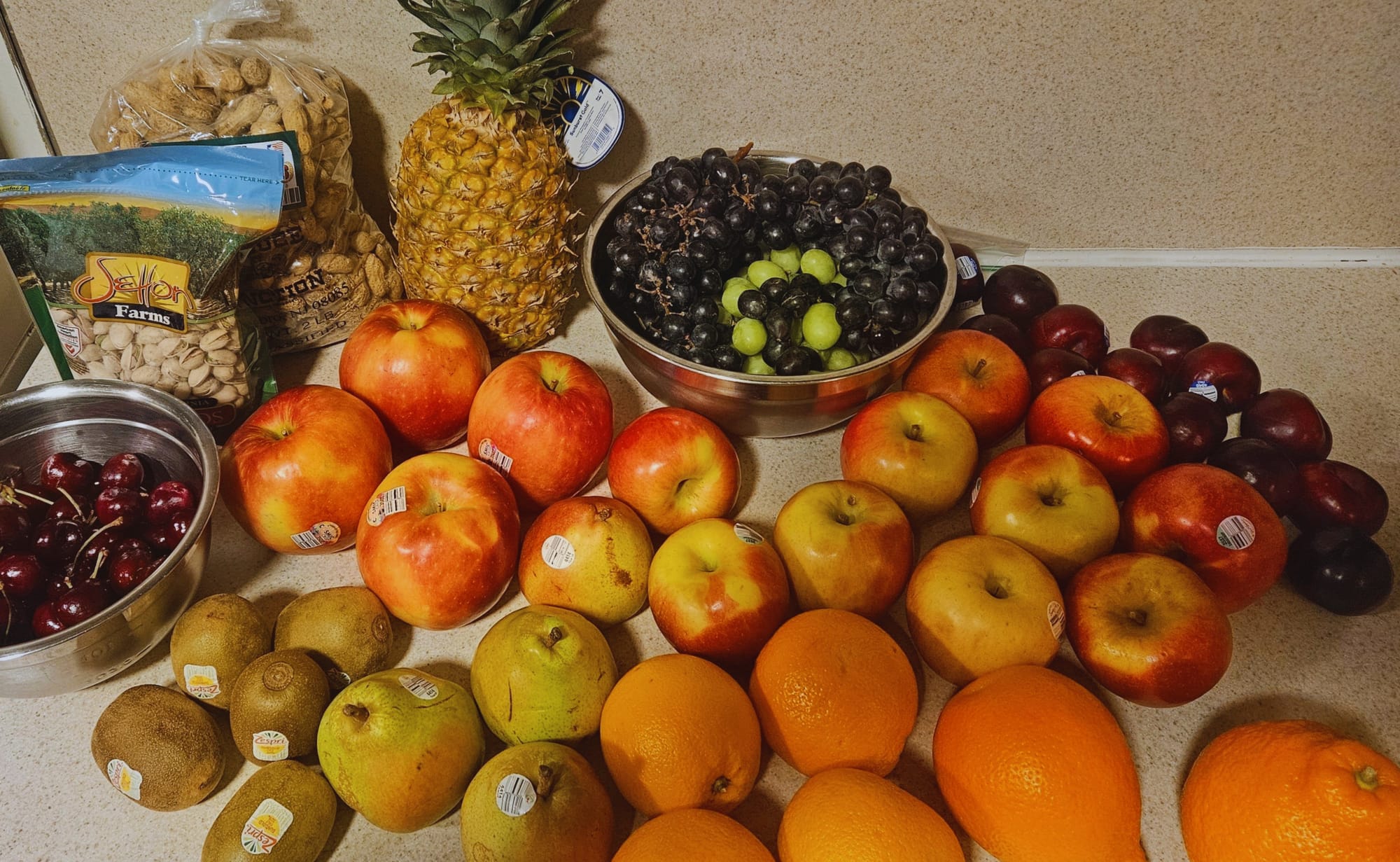
For me, that looks like this. My fruits are oranges, grapefruits, apples, plums, pears, grapes, and kiwis. I eat fried green plantains and peanuts almost daily — that's me, that's my background, that's how I was raised. Chickpea salad and tomato-cucumber salad are weekly staples. I've got a real hankering for BBQ kefta gyros these days. I just discovered Egyptian rice and I can't get enough of it. Mixed vegetables are a dinner non-negotiable, no matter what else is on the plate.
Plenty of other things rotate in seasonally. But I know what I'm eating about 85% of the time. The decisions are already made. The grocery list mostly writes itself. The cooking gets faster every week because I'm cooking the same things in slightly different ways.
That's what staples look like in real life. Not boring. Not restrictive. A short list of foods I genuinely love, drawn from my background and what's around me, repeated often enough that my body has learned to expect them.
What Staples Actually Solve
For someone single and only feeding themselves, building staples is helpful. For anyone feeding a family — anyone with more mouths at the table than their own — staples are not optional. They are the only thing that makes consistent, real-food eating possible at scale.
Without staples, every meal becomes a fresh decision under stress. What's everyone going to eat? What do I have? What's not going to start a fight at the table? Decision fatigue sets in by Tuesday and the family is at a drive-through by Thursday. Not because anyone failed at willpower — because the architecture of the kitchen wasn't built to support real eating.
Staples solve that. A short list of weekly anchors. A small rotation of meals everyone in the house has agreed to eat. The grocery list becomes predictable. The prep gets faster. The kitchen starts running like a system instead of a problem you're solving from scratch every twenty-four hours.
Variety isn't the goal. Real food is the goal. A handful of dishes you love, drawn from your background and your geography, repeated often enough that your body settles into them and your kitchen runs itself.
Eat what you know. Eat where you are. Let the body settle in.