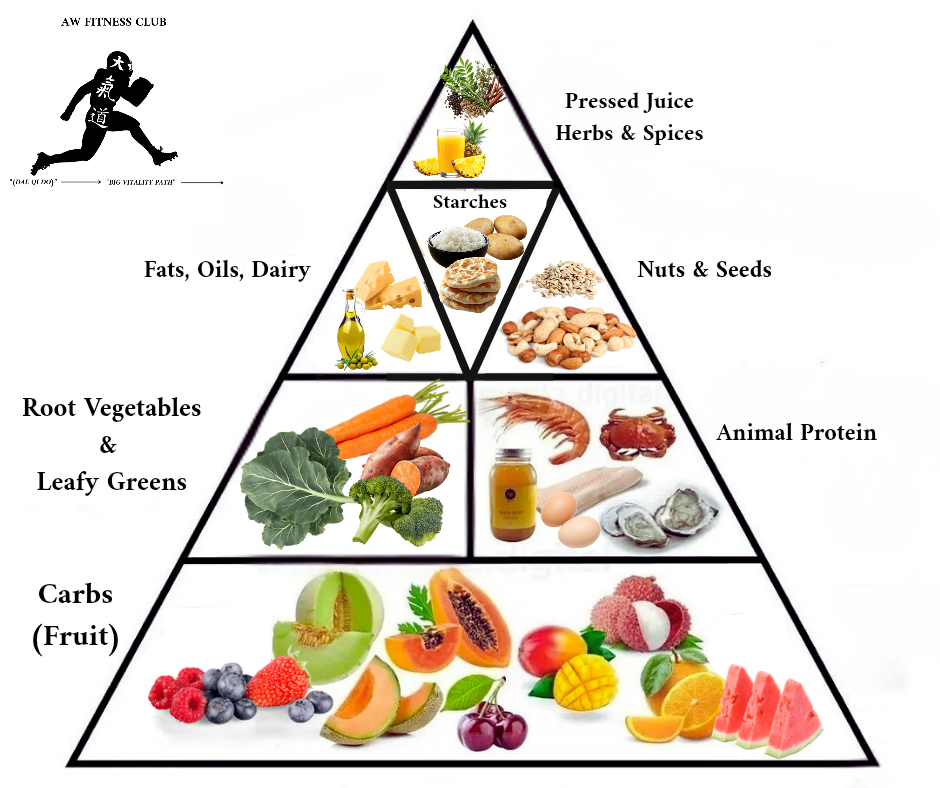
according to the AW Fitness Club
This is how I teach busy parents to eat for metabolic health, fat loss, and sustained energy, without counting calories, restricting food groups, or living hungry.
This isn't a rule-based diet. It's a hierarchy, built around how the human body actually creates energy, recovers, and adapts.
Bottom layer → Fruit carbohydrates
Your body runs cleanest on nature-made carbohydrates.
Fruits hydrate you at the cellular level, giving the lymphatic system the fluid movement it needs to transport and eliminate metabolic waste. Their high water and fiber content gently restores digestion, supports regular elimination, and eases the inflammatory load in the gut.
Fruit sugars provide fast, usable energy that enters the bloodstream with built-in buffers, meaning fiber, minerals, and polyphenols, so you get fuel without the insulin chaos or crash associated with processed carbs.
Just as important, fruits deliver a dense spectrum of micronutrients and phytonutrients that support enzyme activity, feed mitochondrial function, and keep metabolism flexible.
This is why fruit isn't a "snack" in my system. It's the foundation.
Next layer → Root vegetables, leafy greens, and clean animal protein
This layer supplies the materials your body builds with.
Root vegetables and greens bring bulk, minerals, and fermentable fibers that slow digestion, feed beneficial gut bacteria, and stabilize blood sugar across the day.
Clean animal protein contributes essential amino acids needed for tissue repair, immune function, hormone production, and neurological health, without needing excess volume or constant intake.
Together, this layer creates nutrient density without digestive stress, supporting recovery, satiety, and long-term hormonal balance.
This is where the body rebuilds.
Above that → Starches, nuts & seeds, fats/oils, and dairy
These are concentrated fuels, powerful when used intentionally. Starches replenish glycogen, fats and oils support hormone production and cellular integrity, and nuts, seeds, and dairy add density, texture, and staying power.
But because these foods are energy-dense, they work best as supporting players, not the centerpiece. When they dominate the plate, digestion slows, energy becomes inconsistent, and fat loss stalls.
Used correctly, they enhance strength, satisfaction, and training adaptation rather than overwhelming the system.
Top → Pressed juices, herbs, and spices
These are not staples, they're amplifiers.
Pressed juices can deliver targeted nutrients when digestion is compromised. Herbs and spices carry active compounds that support circulation, help calm inflammation, and improve digestive efficiency.
Think of this layer as precision tools rather than daily crutches.
Across every layer → variety
The layers tell you what to reach for. Variety is what turns the hierarchy into a prescription.
Aim for thirty different plants across a week. Not thirty servings, thirty different ones. Herbs count. Spices count at real volume. Beans, nuts, seeds, and whole grains all count. Fermented foods count separately from their raw versions, because sauerkraut does different work in your gut than cabbage does.
Different colors carry different compounds, and those compounds support different systems in your body. Deep greens feed one set of processes, oranges and reds feed another, purples another still. Variety is not a nice extra sitting on top of the real work. It is the work.
Repair the terrain. Don't fear the food.
The goal isn't restriction.
It's alignment: aligning your food choices with how the human body actually produces energy, recovers from stress, and regulates appetite.
When you eat this way:
- Workouts feel easier
- Digestion becomes predictable
- Cravings lose their grip
- Energy stops swinging
- Fat loss becomes a side effect, not a battle
This is what metabolic health looks like in real life.
Related Post: The 7-Step Diet